

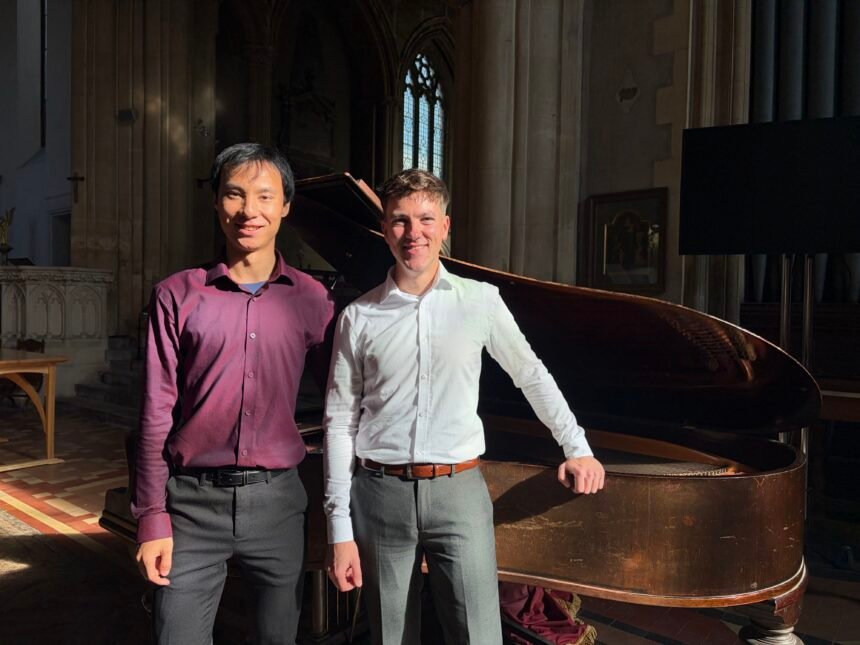
A few weeks ago, I came across some short videos of Duo Digitalis performing on their UK tour. The idea of two pianists tackling Gustav Holst’s The Planets on a single piano was intriguing, but it was the easy communication between them that made me curious. On Friday 16 October, I went to St Mary’s Priory Church in Chepstow to hear them in person.
Those brief clips had offered a glimpse of their timing, but they could not tell me how the music would hold together across a complete programme. Nor could they show what happens when the audience is close enough to notice the small exchanges between performers. It was worth making the trip for that alone.
Blake Huang and Andrew Nesler formed Duo Digitalis in July. Their programme, Earth, the Bringer of Ambivalence, combines a four-hand arrangement of Holst’s orchestral suite with Australian composer Stuart Greenbaum’s Sonata for Piano, 4-Hands. I arrived expecting the Holst to be the main attraction. I left thinking more about Greenbaum.
There is something faintly improbable about fitting The Planets onto one keyboard. Holst’s score depends on orchestral colour, and no amount of dexterity can turn a piano into brass, strings and percussion at once. Fortunately, Huang and Nesler did not try. They brought out the music’s underlying pulse and shape, particularly in the insistent rhythms of Mars, while Venus allowed space for a gentler, more reflective sound.
Huang played with clean articulation and an alert ear for detail. Nesler provided a sense of direction, particularly when the musical texture grew dense. Most importantly, they listened to each other. In a piano duet, even a tiny disagreement about timing can become painfully obvious. Here the coordination felt natural rather than forced.
The revelation, though, was Greenbaum’s Sonata. Written in 2013, it takes ideas about the Sun, the expanding universe and the sight of Earth from space as its starting points. That may sound like an ambitious concept for twenty minutes of piano music, but Greenbaum’s language is surprisingly direct. Repeating patterns, bright harmonies and touches of jazz give the piece an approachable energy without making it predictable.
I particularly enjoyed the way Huang and Nesler handled its shifts between movement and stillness. Huang gave the quicker figures a light, sharply defined touch, while Nesler lent warmth to the more sustained writing. At quieter moments, neither seemed anxious to fill every silence. The result was a genuine musical conversation, not merely two soloists managing to play the same instrument.
There were a few passages where I wanted a little more room for the music to breathe. Some of Greenbaum’s busier writing would have made a stronger impression with greater contrast. But that is a relatively small reservation about a performance that made a convincing case for an unfamiliar piece. I found myself wanting to hear it again, which is more than I can say after every contemporary work I encounter.
The concert’s environmental theme links Holst’s imagined planets with Greenbaum’s view of a fragile Earth. I am wary of asking music to deliver a message about climate change; a worthy subject does not necessarily make a worthy performance. Here, however, the pairing had a musical logic of its own. The sonata was not simply an educational addition to a familiar crowd-pleaser. It held its place alongside Holst.
The setting mattered too. A church coffee concert is a world away from the grander rituals of classical music, and that is part of its appeal. Duo Digitalis have been taking this programme to smaller venues across England and Wales, where audiences can come across new repertoire without the sense that they ought to know it already.
Huang and Nesler are clearly capable pianists, but technical skill was not what stayed with me. It was the feeling that each had room to be himself while working towards something shared. I travelled to Chepstow to hear The Planets played by four hands. I came away with a new composer to explore, and that seems a very good reason to have made the trip.
Stay More Update VENTS MAGAZINE