



AI agents mark a major leap beyond simple chatbots or basic automation tools. These systems perceive their environment, reason through goals, and take independent actions to complete complex tasks with minimal human input. In 2026, businesses across industries adopt them rapidly because they handle multi-step workflows that once required constant oversight.
You no longer just ask a tool a question. You give it a goal, and it plans, executes, adapts, and delivers results. This guide explains exactly what AI agents are, how they differ from earlier AI, their main types, real-world uses, benefits, risks, and practical steps to get started. You will finish with a clear understanding of why autonomous AI systems represent the next big shift in technology and how you can apply them responsibly today.
Understanding the Core Concept of AI Agents
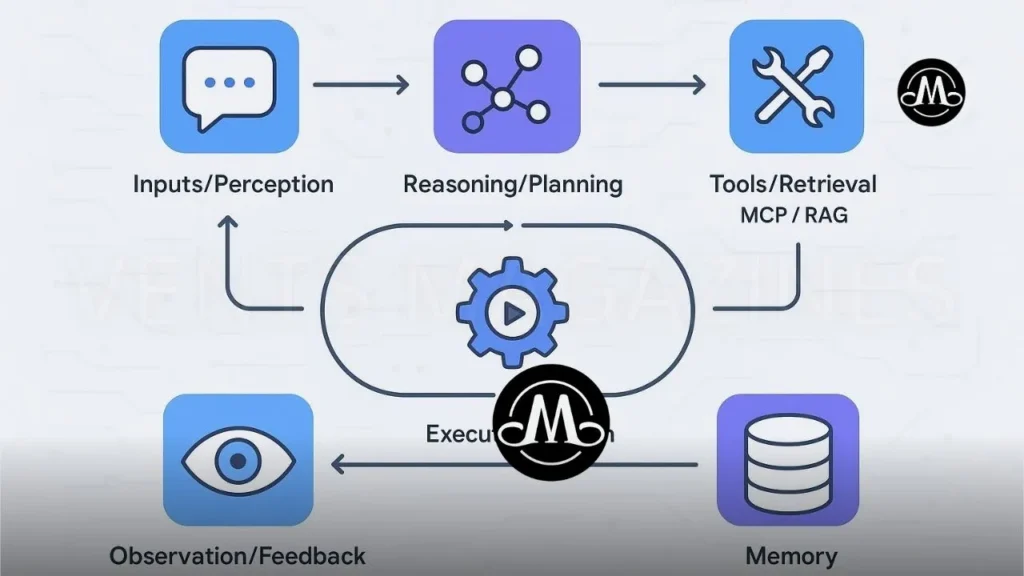
An AI agent functions as an autonomous software system built around large language models. It receives a high-level goal, then breaks that goal into smaller steps, selects appropriate tools, performs actions, observes outcomes, and adjusts its plan as needed. The loop of reasoning and acting often called Re Act sets agents apart from passive systems.
Unlike traditional software that follows strict rules, agents make decisions dynamically. They interact with APIs, browse the web, send emails, update databases, or coordinate with other agents. This agency allows them to pursue objectives even when conditions change midway. In 2026, modern agents also include memory systems that retain context across long sessions and reflection mechanisms that help them evaluate and correct their own performance.
How AI Agents Differ from Traditional Chatbots
Chatbots respond to individual prompts with pre-written or generated answers. They handle one exchange at a time and rarely take real action outside the conversation. AI agents, by contrast, treat the goal as the starting point and actively work toward completion using tools and external systems.
For example, a chatbot might tell you flight options when you ask. An AI agent books the ticket, adds it to your calendar, notifies travel companions, and adjusts the plan if delays occur. This shift from reactive conversation to proactive execution changes how organizations automate work. Agents reduce hand-holding and deliver end-to-end outcomes that save significant time and resources.
The Evolution of AI Agents in 2026
AI agents evolved quickly from experimental projects in 2024–2025 into mainstream enterprise tools. Large language models grew more capable at long-term reasoning, while frameworks standardized tool integration and multi-agent coordination. Companies now embed task-specific agents in 40% of enterprise applications according to industry forecasts.
Standard protocols like MCP for tool connectivity and A2A for agent-to-agent communication make systems more reliable and interoperable. In 2026, you see agents handling everything from customer support workflows to complex research tasks. The technology moved beyond hype into practical, governed deployments that focus on bounded autonomy within clear guardrails.
Main Types of AI Agents and How They Work
Experts classify AI agents into five primary types based on their decision-making approach. Simple reflex agents react instantly to current conditions using fixed rules, much like a thermostat that turns on heat when temperature drops. They work fast in stable environments but struggle with complexity.
Model-based reflex agents add an internal representation of the world, so they handle partial information better. Goal-based agents plan sequences of actions to reach specific objectives. Utility-based agents go further by evaluating which outcome delivers the highest overall benefit. Learning agents improve over time through experience and feedback, making them ideal for dynamic settings. Each type suits different needs, from simple monitoring to sophisticated optimization.
Advanced Capabilities That Make Agents Truly Autonomous
Modern agents combine several layers that enable genuine independence. A planning module decomposes goals into subtasks. Tool-use frameworks let them call external services safely. Memory systems maintain context across days or weeks. Reflection loops allow self-correction when results fall short.
In practice, these capabilities let one agent research a topic, draft a report, gather feedback from another agent, and finalize the document. Multi-agent systems take this further by letting specialized agents collaborate like a researcher agent feeding data to a writer agent coordinated by a manager agent. This orchestration handles enterprise-scale workflows that single models cannot manage alone.
Real-World Applications Across Industries
Businesses deploy AI agents in customer service to qualify leads, process returns, and schedule follow-ups without constant human intervention. In sales and marketing, agents personalize campaigns, analyze performance data, and adjust strategies in real time. Healthcare organizations use them to review patient records, flag anomalies, and prepare summary reports for doctors.
Finance teams automate compliance checks, invoice processing, and fraud detection. Software development benefits from coding agents that debug, write tests, and even deploy updates. In 2026, you also see agents in logistics optimizing routes, in HR screening resumes, and in creative fields generating initial concepts for review. The common thread remains turning high-level goals into completed work.
Popular Frameworks and Tools for Building AI Agents
Developers choose from several mature frameworks in 2026. LangGraph stands out for production-grade control through stateful graphs that manage complex workflows reliably. CrewAI simplifies multi-agent collaboration with minimal code, making it popular for quick prototyping. OpenAI’s Agents SDK offers lightweight, provider-agnostic multi-agent support.
Other strong options include AutoGen for conversational setups, Google’s Agent Development Kit, and Anthropic’s tools optimized for safety. These frameworks handle planning, tool calling, memory, and monitoring out of the box. You select based on your needs—speed for prototypes or robustness for enterprise deployment. Most integrate with leading large language models while adding governance layers.
Benefits of Implementing Autonomous AI Systems
Organizations that adopt AI agents report major gains in productivity and efficiency. Agents handle repetitive yet variable tasks 24/7 without fatigue, freeing humans for strategic work. They reduce errors in rule-based processes and scale operations without proportional staff increases. Employee satisfaction often rises when mundane work disappears.
Businesses also gain faster decision-making because agents analyze data and suggest or execute actions in real time. Cost savings appear in customer support, operations, and back-office functions. In competitive markets, the ability to automate complex workflows creates meaningful differentiation and accelerates innovation.
Potential Risks and Challenges to Consider
Despite clear advantages, AI agents introduce new risks that leaders must address. Security concerns top the list, including prompt injection attacks, data leakage, and unauthorized actions. Inaccuracy remains a serious issue when agents hallucinate or misinterpret goals in ambiguous situations.
Integration with legacy systems often proves difficult and expensive. Governance gaps can lead to accountability questions who owns mistakes when an agent acts autonomously? Workforce impacts require careful change management to avoid resistance or job displacement fears. Many initiatives fail due to weak ROI tracking or insufficient testing in real conditions. Successful deployments always combine strong technical controls with clear human oversight.
Ethical and Governance Considerations for AI Agents
Responsible use demands explicit guardrails from the start. Define clear boundaries on what agents can and cannot do. Implement logging, audit trails, and escalation paths for sensitive decisions. Regular testing for bias, fairness, and safety helps maintain trust.
Transparency matters—users should know when they interact with an agent rather than a human. Organizations benefit from assigning accountability to specific teams or roles. In 2026, regulatory scrutiny increases, so aligning with emerging standards around data privacy and AI risk management protects both reputation and operations. Ethical design ultimately supports sustainable adoption.
How to Get Started Building or Deploying AI Agents
Begin with a well-defined, bounded use case that delivers quick value, such as automating lead qualification or report generation. Choose a framework that matches your team’s skills CrewAI for simplicity or LangGraph for control. Start small with human-in-the-loop oversight to build confidence.
Test thoroughly in simulated and real environments. Monitor performance metrics like success rate, cost per task, and user satisfaction. Iterate based on feedback. Train staff on how to collaborate with agents rather than fear them. Scale gradually once you prove reliability. Many companies pilot one agent, measure results, then expand to multi-agent systems.
The Future Outlook for Autonomous AI Systems
In the coming years, multi-agent architectures will become standard as specialized agents collaborate on increasingly complex projects. Improved reasoning models, better memory, and standardized communication protocols will raise reliability. Expect tighter integration with physical systems through robotics and IoT.
Challenges around trust, security, and regulation will shape development. Organizations that invest early in governance and talent will gain the biggest advantages. AI agents will not replace humans but will augment capabilities, letting people focus on creativity, empathy, and high-level strategy. The shift toward intent-based computing where you state what you want and agents figure out how—continues to reshape work and daily life.
Conclusion
AI agents represent the evolution from tools that answer questions to systems that accomplish goals independently. They combine reasoning, tool use, memory, and adaptation to deliver real outcomes in a fast-moving world. Understanding their types, capabilities, applications, benefits, and risks helps you approach them thoughtfully.
In 2026 and beyond, success depends on balancing autonomy with responsibility. Start with clear objectives, robust frameworks, and human oversight. When implemented well, autonomous AI systems boost productivity, spark innovation, and free time for what matters most. The technology offers powerful potential your approach determines how effectively you harness it.
Frequently Asked Questions
What exactly makes an AI agent different from a regular chatbot?
AI agents pursue goals autonomously by planning steps, using tools, and adapting based on results, while chatbots mainly respond to individual prompts within a conversation.
Are AI agents ready for full enterprise deployment in 2026?
Many organizations use them successfully for specific tasks with guardrails, though full unsupervised autonomy still requires careful testing and human oversight for critical processes.
Which industries benefit most from AI agents right now?
Customer service, sales, finance, healthcare, logistics, and software development see strong results through workflow automation and data-driven decision support.
What are the biggest risks when using AI agents?
Key risks include security vulnerabilities, inaccurate outputs, integration challenges, accountability gaps, and potential negative workforce impacts if not managed responsibly.
Stay Connected with VENTS MAGAZINES